The Angkor dynasty lasted from 802 to 1432. During that period the succession of kings was either hereditary or by usurpation. The first kings were Hindu but there were many Buddhist kings mixed in over the six centuries.
Many rulers decided to build massive stonework temples to honor their respective deities. Often the temple was the centerpiece of a fortified city where the king set up his capital. As the official religion changed, a new temple of Buddhist design would be built next to a Hindu shrine, or the same temple might be renovated to create odd juxtapositions of Buddha and Vishnu statuary.
 The grandest of them all is Angkor Wat, which appears on the current flag of Cambodia. This temple/city is near the modern town of Siem Reap, as are many of the other major Angkor-era temples. Thus, Siem Reap is a busy tourist center, where a significant proportion of the buildings are hotels.
 Jacquie concentrated on the bas-relief galleries along the cloister-like walls of the perimeter.


I was drawn to the high central tower, requiring ascending and descending somewhat vertiginously steep stairways. The temples remain active, in the sense that people have small shrines in the hallways where they will sell you an incense stick to burn for Buddha or Vishnu, similar to lighting a candle in a Christian holy site.

One especially large Vishnu statue is located in the smaller "entry" temple, probably displaced during a Buddhist "reimagining" of the Wat.
On the way back to the tuk-tuk, Lady Gaga served us coffee.

 Each fortified city is surrounded by large stone walls, and the few gates are adorned by yet more stonework - bridges that straddle the moats and often many large Buddha heads or elephants lining the roads.
The number two attraction is the Bayon temple, part of the much larger Angkor Thom complex. Bayon is smaller than Angkor Wat, and both benefits and suffers from its more intricate stoneworks.
 Restoration is ongoing, with piles of rubble all about. Thus, the crowds in the "lesser" temples like Bayon clog the small passageways, making the experience frustratingly slow and a bit claustrophobic, but the carvings and maze-like structure are more intimate and accessible than the grandiose Angkor Wat. Bayon is noted for its many Buddha faces, especially the large four-sided ones.
Jacquie waited while I ventured to the mountainous Baphuon temple. Although not nearly as big as Angkor Wat or even Bayon. Baphuon's central tower represents the sacred Mount Meru of Hindu mythology. Unfortunately for me, the final tower was inaccessible due to restoration.

We were both fatigued, so we rejoined Sitha an hour early and had him take us to the one other temple I really wanted to see, Ta Prohm. Like Bayon, Ta Prohm is in disrepair, but it is fascinating because it is engulfed in trees that seem to be grasping and consuming the stone walls and towers.


The ride back to Siem Reap gave us the first opportunity to see the city, since the airport ride and the pre-sunrise ride were in the dark. The hotel bed was overwhelmingly inviting, making us sleep through our first scheduled massages. Later our second day, we eventually got the massages (mmmm!).
Many rulers decided to build massive stonework temples to honor their respective deities. Often the temple was the centerpiece of a fortified city where the king set up his capital. As the official religion changed, a new temple of Buddhist design would be built next to a Hindu shrine, or the same temple might be renovated to create odd juxtapositions of Buddha and Vishnu statuary.
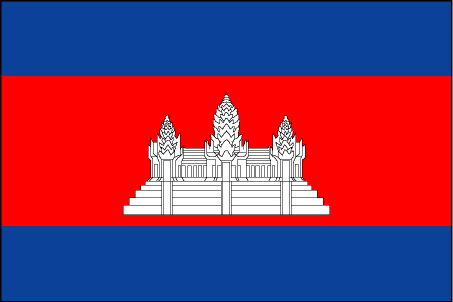 The grandest of them all is Angkor Wat, which appears on the current flag of Cambodia. This temple/city is near the modern town of Siem Reap, as are many of the other major Angkor-era temples. Thus, Siem Reap is a busy tourist center, where a significant proportion of the buildings are hotels.
We were encouraged to experience the sunrise at Angkor Wat to start off our "small tour"of the temples. There were hundreds of visitors gathered at the sacred pool near the main temple as the sun rose behind it, back-lighting the numerous towers arranged symmetrically around the square edifice. Our tuk-tuk man, Sitha, let us off and left us to ourselves for 2-3 hours as we wandered about the complex architecture. A kid sold me a couple of guide/picture books which we were able to read a bit later when it got light enough to see.


I was drawn to the high central tower, requiring ascending and descending somewhat vertiginously steep stairways. The temples remain active, in the sense that people have small shrines in the hallways where they will sell you an incense stick to burn for Buddha or Vishnu, similar to lighting a candle in a Christian holy site.

One especially large Vishnu statue is located in the smaller "entry" temple, probably displaced during a Buddhist "reimagining" of the Wat.
On the way back to the tuk-tuk, Lady Gaga served us coffee.

 Each fortified city is surrounded by large stone walls, and the few gates are adorned by yet more stonework - bridges that straddle the moats and often many large Buddha heads or elephants lining the roads.
The number two attraction is the Bayon temple, part of the much larger Angkor Thom complex. Bayon is smaller than Angkor Wat, and both benefits and suffers from its more intricate stoneworks.
 Restoration is ongoing, with piles of rubble all about. Thus, the crowds in the "lesser" temples like Bayon clog the small passageways, making the experience frustratingly slow and a bit claustrophobic, but the carvings and maze-like structure are more intimate and accessible than the grandiose Angkor Wat. Bayon is noted for its many Buddha faces, especially the large four-sided ones.
Jacquie waited while I ventured to the mountainous Baphuon temple. Although not nearly as big as Angkor Wat or even Bayon. Baphuon's central tower represents the sacred Mount Meru of Hindu mythology. Unfortunately for me, the final tower was inaccessible due to restoration.

We were both fatigued, so we rejoined Sitha an hour early and had him take us to the one other temple I really wanted to see, Ta Prohm. Like Bayon, Ta Prohm is in disrepair, but it is fascinating because it is engulfed in trees that seem to be grasping and consuming the stone walls and towers.


The ride back to Siem Reap gave us the first opportunity to see the city, since the airport ride and the pre-sunrise ride were in the dark. The hotel bed was overwhelmingly inviting, making us sleep through our first scheduled massages. Later our second day, we eventually got the massages (mmmm!).

No comments:
Post a Comment